Choosing Boilie Size for Cautious Carp: When to Go Smaller
Smaller boilies are not automatically less suspicious. Choose diameter around feeding behaviour, nuisance fish and the amount of bait on your spot.
By Boilies.com· · 2 min read
Start with the feeding situation
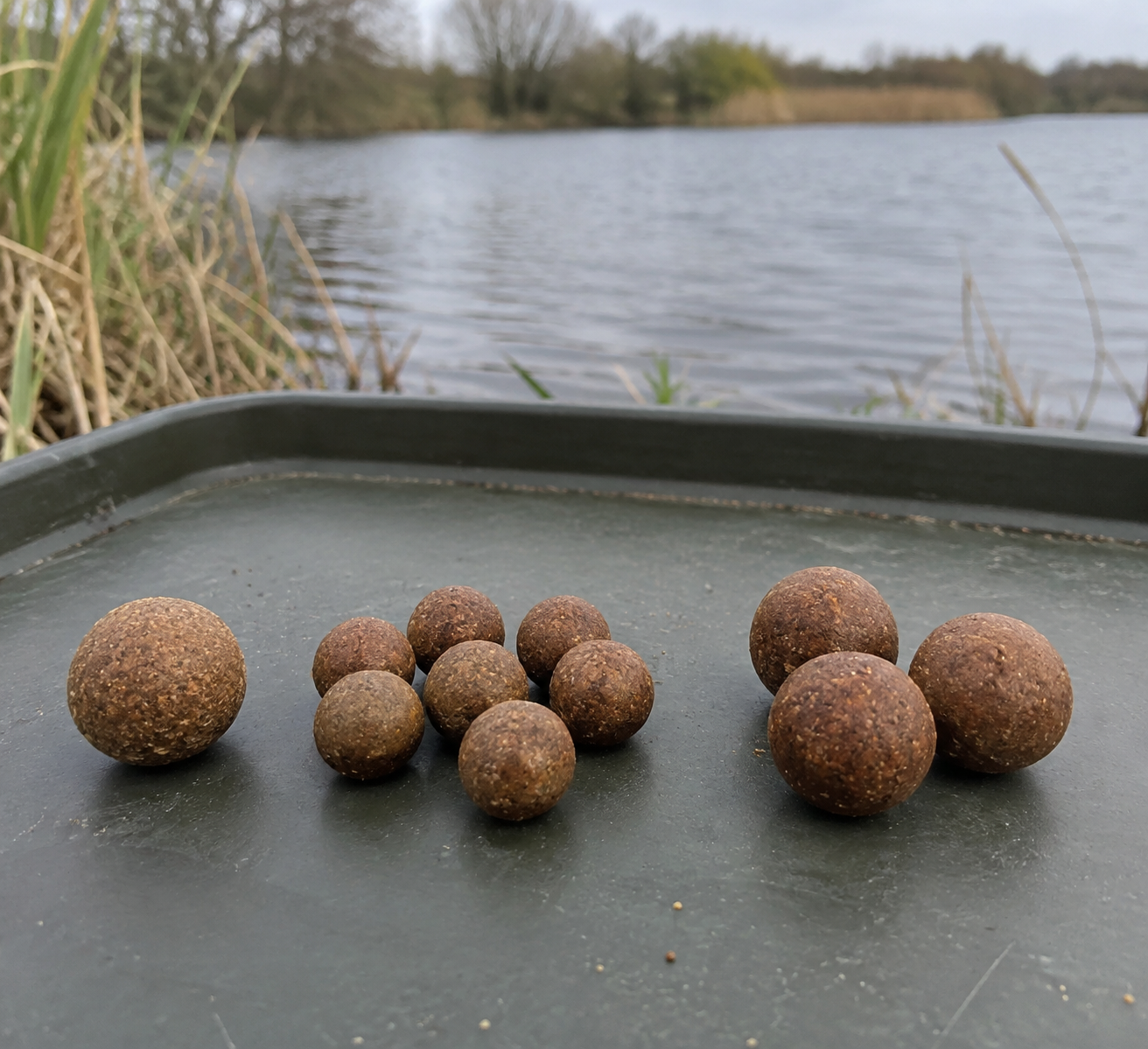
Choose boilie diameter around what carp can pick up confidently, not the assumption that cautious fish always want tiny baits. A 10–12 mm boilie offers a small mouthful, while 15–18 mm provides a useful middle ground. Larger baits, around 20 mm and above, can help reduce attention from some smaller fish, but will not reliably exclude them. Treat these sizes as starting points rather than rules tied to carp weight.
Before downsizing, check whether fish are actually feeding where your bait lies. Showing carp may be travelling or holding above the bottom. If there is no convincing feeding activity, changing location or presentation may matter more than switching from an 18 mm boilie to a 12 mm one.
Make the hookbait fit the food
Where carp are already eating small particles or boilie fragments, a 10–12 mm hookbait can fit the size of food they are collecting. The trade-off is that small baits are easier for nuisance fish to take, and softer versions may disappear quickly. Check bait condition after unexplained indications or when small-fish activity increases.
If carp are feeding on whole 15–18 mm boilies, matching that diameter is a sensible baseline. A smaller hookbait among larger freebies is worth trying, but it is not automatically more discreet: it is still different. On clear, firm ground, matching colour and shape as well as size can avoid making diameter the only feature you consider.
Count baits, not just handfuls
Reducing diameter changes how many individual baits you introduce. For equally dense spherical boilies, a 20 mm bait has roughly eight times the volume of a 10 mm bait. An equal weight of smaller boilies therefore creates many more feeding items. That can encourage searching when spread out, but it can also leave your hookbait among far more alternatives.
When testing smaller boilies, decide whether you want to keep the number of freebies similar or maintain the same total food quantity. You cannot do both simply by keeping the weight unchanged. For a lightly baited approach, count out a modest number rather than replacing a handful of large boilies with a handful of small ones.
Change one size variable at a time
Keep the bait recipe, flavour and feeding pattern consistent while comparing diameters. If you change all three alongside size, any difference in indications or bait damage becomes hard to interpret. Where multiple rods are permitted, comparable spots can offer a useful comparison, although differences between locations prevent it from being a controlled test.
Check that the smaller hookbait still suits your presentation: the hook point and gape should remain unobstructed, and a buoyant bait must be balanced again after a size change. Do not automatically fit a finer hook just because the boilie is smaller; weed, snags and fish size still determine the strength required. Keep the smaller option only if it remains intact and fishes effectively.
Related articles
More inspiration on bait tactics and similar baits.
Bait Tactics
A 48-Hour Carp Session: Build and Adapt Your Boilie Baiting Plan
Plan your opening feed, protect a bait reserve and use clear decision points to adapt over 48 hours without topping up blindly or moving too soon.
23 Oct 2026· 5 min read
Bait Tactics
Whole vs Broken Boilies: Feeding Patterns for Pressured Lakes
Choose whole boilies, halves or coarse fragments around the feeding pattern you need—not the assumption that pressured carp always prefer smaller pieces.
23 Oct 2026· 3 min read
Bait Tactics
Check Boilie Hookbait Softness Before a Short Session
A gentle squeeze and a spare-bait needle check can reveal whether a boilie is suitable for mounting or needs replacing before a short carp session.
23 Oct 2026· 1 min read