Whole vs Broken Boilies: Feeding Patterns for Pressured Lakes
Choose whole boilies, halves or coarse fragments around the feeding pattern you need—not the assumption that pressured carp always prefer smaller pieces.
By Boilies.com· · 3 min read
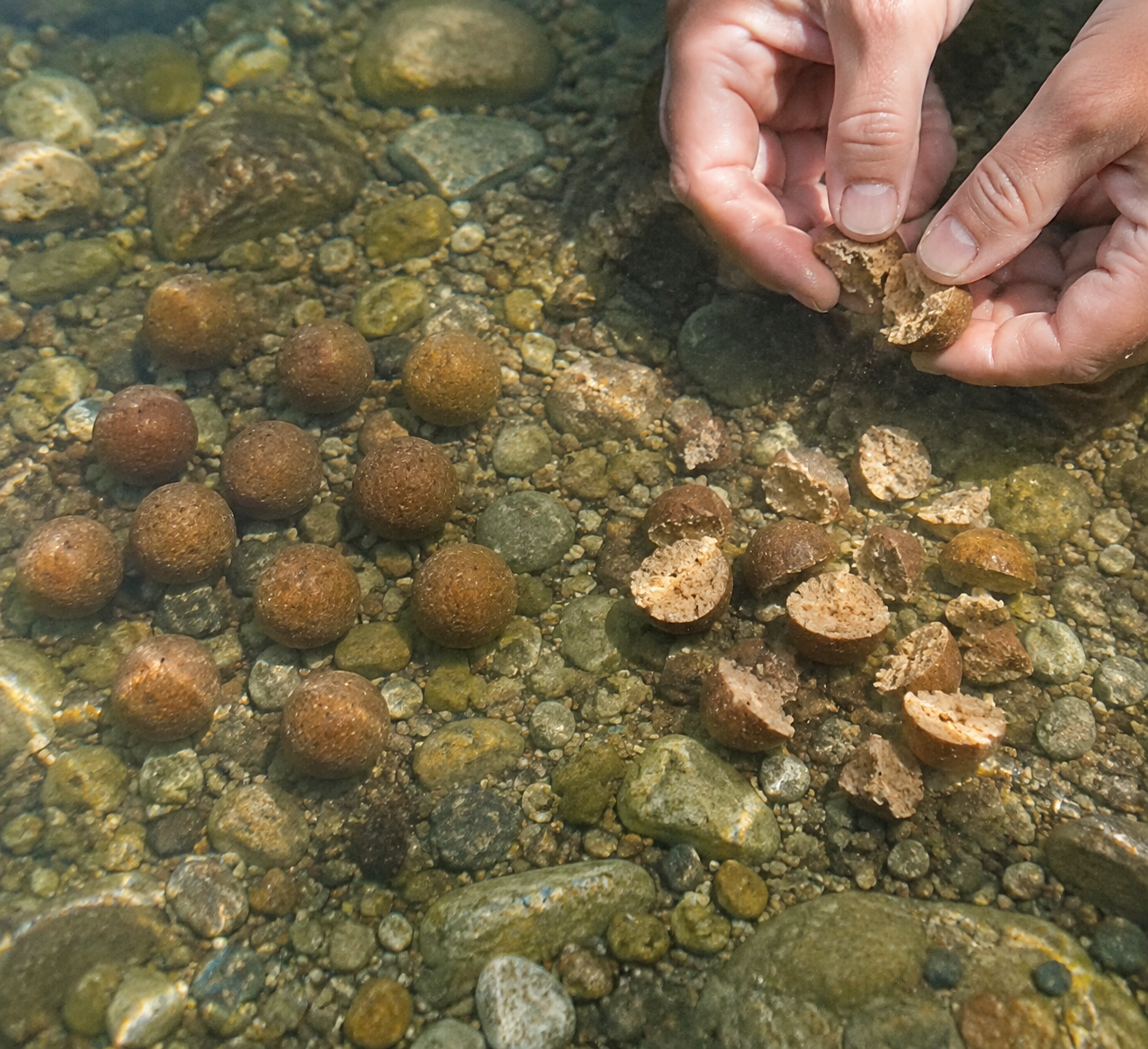
Choose the footprint before the bait shape
On pressured lakes, decide where you want carp to search before deciding whether to feed whole or broken boilies. A loose spread encourages fish to investigate separate food items; a compact patch puts more food within a small area. Neither guarantees confident feeding. Choose a footprint that suits the clear bottom available, your casting accuracy and the route fish appear to use, rather than automatically building a tight pile around the hookbait.
Separate bait shape from bait quantity. Breaking ten boilies creates more pieces, not less food. When comparing patterns, keep the starting quantity similar and change either the spread or the proportion of broken bait. Changing both at once makes any response harder to interpret. Use the same scoop or weigh portions at home if estimating a handful repeatedly proves unreliable.
Use whole boilies to maintain separation
Whole boilies are useful when you want distinct feeding points across a clean area. Their consistent shape makes them easier to distribute with a throwing stick, although wind, range and technique affect accuracy. Start with a spread you can reproduce rather than the widest one you can achieve. Put the hookbait within that feeding area, not automatically at its centre or beyond its edge.
Round baits can roll on slopes or firm, uneven ground, so the landing point is not necessarily the final feeding spot. Where a slope runs towards weed or an obstruction, choose a flatter area or consider halves. Whole boilies also leave larger individual mouthfuls and may withstand small-fish attention longer than fragments, but they do not reliably exclude nuisance species or crayfish.
Break bait for a different distribution
Halves and coarse fragments create irregular food items and expose the inside of the bait directly to water. That changes how soluble ingredients can escape, but does not establish a universal attraction advantage. Use a baiting spoon, bait boat where permitted, or a spod or Spomb-style bait rocket to place fragments; a throwing stick is unsuitable for distributing them predictably.
Keep some substantial pieces if you want food to remain available after small fish investigate. Fine crumb can settle between stones, disappear into weed or be carried away during delivery and descent. It may encourage prolonged searching, but can also draw unwanted fish without leaving much accessible food for carp. On a silty or lightly debris-covered spot, favour coarse pieces over powder and avoid assuming a visible surface cloud marks the bottom feeding area.
Match the hookbait to an accessible mouthful
A whole bottom bait can sit among broken freebies without needing to copy every fragment. Its advantage is a durable, mountable mouthful; its trade-off is being more uniform than the surrounding food. If you use a trimmed boilie instead, check that it stays secure on the hair and leaves the hook point and gape unobstructed. Test the complete rig in the margin before casting.
Do not choose hookbait buoyancy solely because the feed is broken. Select a bottom bait, balanced presentation or pop-up according to the lakebed and rig mechanics. A buoyant hookbait placed over fragments still needs reliable anchoring and suitable hook clearance. Where debris hides the hook, moving to a cleaner patch may be a better adjustment than adding more bait.
Adjust one feature after useful evidence
For an unfamiliar spot, a modest mixed portion of whole boilies and halves offers a practical starting point. Place it over an area you can fish accurately, and keep a matching portion ready rather than feeding it immediately. If the lake allows multiple rods, compare patterns only on spots you can present effectively; differences in depth, cover and fish traffic can outweigh bait shape.
Top up in response to credible feeding evidence, not simply elapsed time. A bite, visible feeding or repeated activity over the spot can justify another small portion, but liners alone do not prove the bait has been eaten. If small fish are clearly stripping fragments, increase the whole-bait proportion. If food appears to roll away, alter the location or use flatter pieces. Record quantity, distribution and observations so the next adjustment addresses a specific problem.
Related articles
More inspiration on bait tactics and similar baits.
Bait Tactics
A 48-Hour Carp Session: Build and Adapt Your Boilie Baiting Plan
Plan your opening feed, protect a bait reserve and use clear decision points to adapt over 48 hours without topping up blindly or moving too soon.
23 Oct 2026· 5 min read
Bait Tactics
Check Boilie Hookbait Softness Before a Short Session
A gentle squeeze and a spare-bait needle check can reveal whether a boilie is suitable for mounting or needs replacing before a short carp session.
23 Oct 2026· 1 min read
Bait Tactics
Choosing Boilie Size for Cautious Carp: When to Go Smaller
Smaller boilies are not automatically less suspicious. Choose diameter around feeding behaviour, nuisance fish and the amount of bait on your spot.
6 Oct 2026· 2 min read